Tear-off · Restoration · Retrofit · Greater Houston
Commercial Roof Replacement in Greater Houston
When a commercial roof has stopped being worth repairing, there are three honest answers: a full tear-off and replacement, a restoration coating, or a retrofit over what is already there. JC&C Roofing Company surveys the roof, tells you which ones your building is genuinely a candidate for, and prices them side by side.
We do not publish a price table for commercial replacement, and we would not trust one that did. A distribution warehouse and a two-story medical office share almost nothing — deck, existing layers, insulation, drainage, code, access and how the building is occupied all change the work. Every project demands different things. What we publish instead is exactly what drives the number, and how we arrive at it.
- Written options, never a single number Tear-off, restoration and retrofit costed beside each other, so you can take it to a budget meeting instead of asking someone to trust one figure.
- Phased around how the building is used Sections sequenced so tenants keep trading, and the roof is watertight every night before the crew leaves.
- Free survey, and the report is yours Moisture readings, core cuts where they are needed, drain and detail photographs — whether you hire us or not.
- Since 2013 in business
- 8 systems installed
- 4.8★ over 400 reviews
- 0 BBB complaints
What a replacement includes
- Tear-off and disposalExisting membrane and layers removed, dumpsters staged where they do not block you.
- Deck repairEvery soft or corroded section replaced before anything goes over it.
- Insulation and tapered workSpecified to current code, and shaped so water reaches a drain.
- The system itselfSingle-ply, modified bitumen, built-up or metal panel, fastened or adhered to the wind uplift the building requires.
- Details and penetrationsCurbs, pipes, skylights, scuppers, drains, edge metal and wall terminations.
- Warranty registeredManufacturer system warranty where the assembly qualifies, plus our own workmanship warranty in writing.
Repairs, emergency response and leak detection on commercial buildings live on our commercial roof repair page.
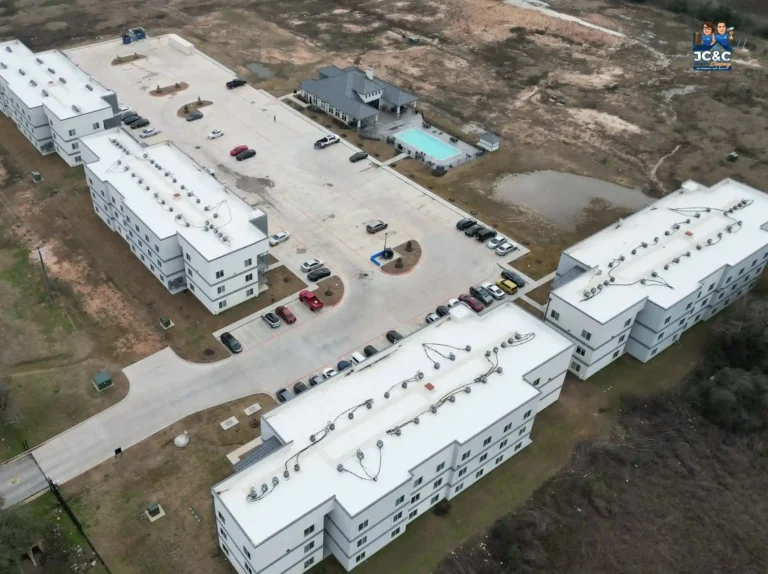
Three paths, not one
Replacement is one of three answers. A contractor who only ever gives you that one is not surveying your building.
There is a real middle ground on a commercial roof that does not exist on a house. Here is what each path is, when it is the right one, and — just as important — when it is not.
-
Path 1
Restoration coating
A silicone or acrylic system over a membrane that is still structurally sound. The least disruptive of the three, and the cheapest by a wide margin when the roof qualifies.
- Right whenThe membrane is aging but intact, the deck and insulation are dry, seams are sound, and you need years rather than decades.
- Not right whenMoisture is trapped in the insulation, seams are failing across the field, or the deck has soft areas. Coating over that hides the problem and buys very little.
- What it buysAdded service life and a reflective surface that lowers the heat load, with no tear-off, no dumpsters and almost no disruption below.
-
Path 2
Retrofit and recover
A new system installed over the existing one, usually with a cover board or new insulation between. Far more often possible than property managers expect.
- Right whenThere is only one existing roof layer, the deck is sound, moisture readings come back dry, and the building can carry the added weight.
- Not right whenTwo layers are already on the building, the survey finds wet insulation, or the deck needs work you cannot reach from above.
- What it buysA full new membrane and a manufacturer warranty without the cost, noise and exposure of tearing the old roof off first.
-
Path 3
Full tear-off replacement
Everything comes off down to the deck, and the roof is rebuilt as a specified assembly. The most expensive path, and sometimes the only honest one.
- Right whenInsulation is saturated, the deck needs repair, layers have already been stacked, or you intend to hold the building long enough that a new assembly is the cheaper decision over time.
- Not right whenThe roof is simply old. Age on its own is not a diagnosis, and we will tell you when the survey does not support a tear-off.
- What it buysA known assembly, a dry deck, drainage corrected rather than inherited, and the longest manufacturer warranty the building can qualify for.
What decides it — and it is not the sales visit
The three paths are separated by measurements, not opinion. This is what we take before a proposal is written, and you receive all of it whether you hire us or not.
- Moisture surveyInfrared or capacitance readings across the field, to find wet insulation that looks identical to dry insulation from above.
- Core cutsSmall samples opened and sealed, so we can count the existing layers and see the deck rather than guess at both.
- Drainage and pondingWhere water sits after rain. Ponding is the single most reliable predictor of a roof that will fail early.
- Details and penetrationsCurbs, pipes, skylights, edge metal and wall terminations — where commercial roofs actually fail, far more often than the field.
- Deck and structureCondition, fastener holding, and whether the building can carry a recover at all.
- How you use the buildingTrading hours, tenant access, rooftop equipment and how long you plan to hold it. This changes the recommendation as much as the roof does.
If the survey says repair rather than replace, we will say so. That work, and emergency response on commercial buildings, is set out on our commercial roof repair page.
Systems
Commercial Roofing Systems We Install
The right system depends on slope, drainage, rooftop equipment, what happens underneath and how long you intend to hold the building. Here is what each one is good at, what it costs you in trade, and what we specify it on.
-

Where commercial roofs actually failNot across the field. At the curbs, the equipment, the pipe penetrations and the terminations — which is why a replacement proposal that does not itemize the details is not a proposal. -
TPO going downA low-slope replacement mid-installation. The curbs are flashed before the field is closed, not after — the order of work is most of the difference between a roof that lasts and one that does not.


-
01
TPOThermoplastic polyolefin
The default single-ply on Houston flat roofs, and usually the best value per year of service. The reflective white surface measurably lowers the heat load on the building, which matters on the Gulf Coast.
Heat-welded seams are its strength and its weak point at once: welded properly they outlast the membrane, welded badly they are the first thing to open.
We specify it onOffices, retail centers, warehouses, medical and dental buildings, multifamily
-
02
PVCPolyvinyl chloride
Single-ply with chemical and grease resistance TPO does not have, which is why it belongs over commercial kitchens and anywhere the exhaust puts oil onto the roof.
It costs more per square foot. On the wrong building that is money wasted; over a kitchen it is the difference between a roof that lasts and a membrane that softens.
We specify it onRestaurants, commercial kitchens, food service, laundries, grocery
-
03
EPDMRubber membrane
Long-established rubber roofing, and among the most repairable systems there is — a real advantage on a building you plan to hold for a long time.
The trade is heat. Black EPDM absorbs rather than reflects, so on a conditioned Houston building we will usually walk you through what that costs in cooling before you choose it.
We specify it onWarehouses, unconditioned space, older commercial buildings being kept long term
-
04
Modified bitumenTorch-down and self-adhered
A multi-ply asphalt system, tough underfoot and forgiving of the traffic a roof gets when somebody services rooftop equipment every month.
Redundancy is the point: more than one ply means a puncture in the cap sheet is not immediately a leak in the building.
We specify it onBuildings with heavy rooftop equipment, mixed-use, frequent roof access
-
05
Built-up (BUR)Tar and gravel
The traditional layered assembly, still on a great many Houston buildings and still a valid specification where durability under traffic matters more than reflectivity.
The honest drawback is diagnosis: a leak under gravel is harder to trace than a leak in a single-ply field, which is worth knowing before you commit to another one.
We specify it onOlder offices, schools, institutional buildings matching an existing assembly
-
06
MetalStanding seam and panel
The longest service life of anything on this list, and the one system where replacement is most often unnecessary — metal fails at fasteners, seams and penetrations rather than across the panel.
Where a full replacement is right, standing seam removes the exposed fasteners that caused the trouble in the first place.
We specify it onWarehouses, churches, retail, agricultural buildings, steep-slope commercial
-
07
Restoration coatingsSilicone and acrylic
Not a replacement, and we do not present it as one. On a sound membrane a coating system renews the surface and adds years for a fraction of what a tear-off costs.
It is the wrong answer on a wet roof, and the survey is what tells us which one you have.
We specify it onAging membranes in fair condition, dry insulation, sound seams
-
08
Flat & low-slopeTapered insulation and drainage
The common thread across almost every Houston commercial roof, and the part of a replacement most often left out of a cheap quote.
Replacing a membrane without correcting drainage rebuilds the same failure on a new roof. Tapered insulation, additional drains or scuppers cost money up front and are usually the reason one proposal is higher than another.
We specify it onAlmost every commercial replacement we quote
Not sure what is on your roof? Most property managers are not, and there is no reason they should be. We identify the assembly during the survey, at no charge, and tell you how many layers are already up there — which on its own rules one of the three paths in or out.
Independent references
Worth reading if you are specifying a system rather than taking our word for it. These are industry bodies and manufacturers, not us.
Property types
Buildings We Replace Roofs On Across Greater Houston
Roof type, age, slope, drainage and how the building is used all change what the right answer is. So does who is inside while we work — on a commercial replacement that is usually the harder half of the job.
-

Assisted livingSeveral wings, two roof types on one property, and residents in place throughout. Work here is planned wing by wing, and noise is scheduled rather than apologized for. -

Shopping centerOne roof, many tenants, and a modified bitumen field that has been patched more than once. Surveying a roof like this is the only way to know whether it needs a coating, a recover or a tear-off.


-
Office buildings
Flat and low-slope assemblies, drainage that has to be corrected rather than inherited, and a sequence planned floor by floor instead of closing the building.
-
Retail centers
Multiple units under one roof, so one failure becomes several tenants’ problem at once. Phased so no storefront loses its trading day.
-
Warehouses and distribution
Large spans, metal and single-ply, and stock underneath that cannot get wet. Dry-in is planned before tear-off starts, not decided when the weather turns.
-
Restaurants and hotels
Grease exposure around kitchen exhausts, which usually decides the membrane, and work timed outside service hours and guest floors.
-
Churches and schools
Older buildings, mixed assemblies, and budgets set well in advance — so the proposal has to survive a board meeting, not just a phone call.
-
Medical and dental offices, clinics
Sensitive equipment, controlled access, and no tolerance for water intrusion. Noise and dust are planned around patient hours.
-
Multifamily
Residents in place throughout, and a roof that covers a lot of separate homes. Notices, parking and staging matter as much as the membrane.
Where we are not the right call
We would rather tell you now than waste your time. JC&C does not take industrial and manufacturing plants, government and public works contracts, or hospitals. Those projects carry requirements a company our size should not pretend to carry.
Clinics, medical offices and dental practices we do work on, and regularly.
Scheduling matters as much as the roof
Most of our commercial work is timed around trading hours, tenant access or service periods, and a replacement is sequenced so the building is watertight every night before the crew leaves. Tell us the constraint early and we will build the schedule around it — it is far cheaper to plan for than to work around later.
Also from this office
- The Houston office — Spring Branch Who covers your building, and from where
- Commercial roof repair Leaks, emergencies and 24/7 response
- Residential roof replacement Houses, townhomes and small multifamily
- Storm damage and insurance claims Documenting hail and wind on a commercial roof
- Financing options When the roof will not wait for next year’s budget
What drives the number
What a Commercial Roof Replacement Costs, and Why We Will Not Print a Table
On our residential pages we publish every price we charge, because a shingle repair is close enough to the same job on every house. Commercial is not that. Every project demands different things, and every customer has different requirements — a published square foot rate would be a marketing number, not your number.
So here is the honest version: these are the nine things that actually move a commercial replacement, and the process we use to turn them into a figure you can take to a budget meeting.
Roof area, and how it is cut up
Square footage is the smallest part of it. Curbs, units, pipes, skylights and parapets are where the labor goes, and two roofs of identical size can be very different jobs.
What is already up there
One existing layer may allow a recover. Two usually forces a tear-off, and tear-off brings disposal, dry-in and exposure that a recover does not.
Deck type and condition
Steel, concrete, wood or gypsum, and how much of it is sound. Corroded deck and poor fastener holding are found by survey, not guessed at, because they change the attachment method.
Insulation and current code
A replacement usually has to meet today’s energy code rather than the one the building was built to. That can mean more thickness than came off, which is real cost and not optional.
Drainage
Tapered insulation, added drains, scuppers and overflows. This is the line most often missing from a cheaper proposal, and the reason a new roof can fail like the old one.
The system specified
Membrane type and thickness, mechanically attached or fully adhered, and the wind uplift the building has to meet. All three move the figure independently.
Access and staging
How material gets up and debris gets down. Crane or hoist, where dumpsters can sit, distance from the curb, and whether anything has to be secured overnight.
Occupancy and phasing
Night work, weekend work, or sequencing around tenants costs more than an empty building does. It is usually worth it, and you should see it priced rather than buried.
Warranty term
A longer manufacturer warranty is not a discount item — it requires a heavier assembly and a manufacturer inspection. Choosing the term is a budget decision, so we quote it as one.

This is what a drainage line looks like when it is left out
A TPO roof that never had a maintenance visit. The drain filled with dirt, the dirt held water, and a bush grew in it. The membrane around that drain is finished long before the rest of the field is.
Correcting drainage is the line most often missing from a cheaper proposal. Tapered insulation, added drains, scuppers and overflows cost real money, and leaving them out is usually why one number comes in under another — not better pricing, a smaller job described in the same words.
The number nobody puts on the invoice
On a house, a leak is a leak. On a building with tenants in it, the roofing bill is rarely the real number — and it is why deferring a replacement often saves less than it looks like it saves.
- Tenant complaintsAnd the conversations, emails and goodwill that go with them.
- Damaged stock and equipmentWhatever was underneath, and whatever had to be moved.
- Interrupted tradingFloor space closed off, a bucket in the middle of a showroom, a restaurant seating half its covers.
- Your own timeManaging it, chasing it, explaining it upward. That has a cost even when nobody invoices for it.
None of it appears on a roofing estimate — which is why the cheapest quote is frequently the most expensive outcome. The way to compare proposals is not the total. It is whether all three describe the same assembly, the same drainage work and the same warranty.
How we arrive at your number
- Step 1
Free survey
We walk the roof, photograph the details, and identify the assembly. No charge, and no obligation to use us afterward.
- Step 2
Measurements, not impressions
Moisture readings, core cuts where they are needed, drainage mapped, deck condition confirmed. This is what separates the three paths.
- Step 3
Written options side by side
Restoration, retrofit and full replacement, each costed and each explained — whichever of them your building genuinely qualifies for.
- Step 4
A fixed scope, then a schedule
The proposal states the assembly, the drainage work, the warranty and the phasing, so what you approve is what gets built.
If the survey says your roof does not need replacing, you will get that in writing too. The criteria we use to separate a repair from a replacement, and the diagnostics behind them, are set out on our commercial roof repair page.
To start: call (281) 498-7663 or request a survey. Emergencies are answered 24 hours a day, 365 days a year.
Common questions
Commercial Roof Replacement Questions, Answered
The questions property managers and owners actually ask us before approving a roof.
How long does a commercial roof replacement take?
Days for a small single-tenant building, several weeks for a large warehouse or a phased retail center. Roof size matters less than the number of penetrations, the amount of tapered insulation and how much of the building has to keep operating while we work.
You get a schedule with the proposal rather than after you sign, and the roof is dried in every night before the crew leaves.
Do we have to close, or move tenants out, while the roof is replaced?
Almost never. Commercial replacement is normally phased in sections so the building keeps trading, and on occupied buildings we agree the sequence before starting. For restaurants and retail most of the noisy work happens outside opening hours; for offices we plan around floors rather than shutting the building.
Tell us the constraint early. Scheduling around tenants is far cheaper to plan for than to work around once the tear-off has started.
Can you install a new roof over the existing one?
Often, yes. A retrofit or recover is possible when there is only one existing layer, the deck is sound, the insulation reads dry and the structure can carry the added weight. It avoids the cost, noise and exposure of a tear-off, and it is possible more often than most property managers expect.
It is ruled out by two existing layers, wet insulation or a deck that needs work. Core cuts and a moisture survey answer that question before anyone writes a proposal.
Is a restoration coating a real alternative to replacement?
On the right roof it is an excellent one. A silicone or acrylic system over a membrane that is still sound renews the surface and adds years for a fraction of what a replacement costs, with almost no disruption to the building below.
On the wrong roof it is money thrown away. Coating over a failing membrane or trapped moisture hides the problem rather than solving it, which is why we survey before recommending one and will tell you when the answer is no.
How long should a commercial roof last in Houston?
Gulf Coast heat, humidity and hail are harder on a roof than most of the country, and drainage decides more than the membrane brand does. A well-drained single-ply installed properly should give you a long service life; the same membrane over standing water will not.
Age on its own is not a reason to replace a roof. Wet insulation, deck deterioration, failing seams across the field and drainage that cannot be corrected are the reasons.
What does a commercial roof replacement cost?
We do not publish a table for commercial work, because every project demands different things and every customer has different requirements. Roof area, existing layers, deck condition, code-required insulation, drainage corrections, the system specified, access, phasing and the warranty term all move the figure independently.
What we do publish is the process: a free survey, measurements rather than impressions, and written options for restoration, retrofit and full replacement side by side, so you can take a comparison to a budget meeting instead of a single number and a request to trust it.
Will insurance pay for a commercial roof replacement after hail?
Sometimes, and the dispute is almost always about scope rather than whether damage exists. On commercial buildings the argument is how much of the roof is affected, which is exactly what section-by-section documentation settles. We photograph the roof, document the damage and meet the adjuster on site.
Hail damage frequently does not leak for months, so getting it documented soon after a storm matters more than it seems at the time. More on that on our roof insurance claims page.
What warranty comes with a commercial roof replacement?
Two separate things, and it is worth keeping them apart. The manufacturer warranty covers the system where the assembly qualifies, and the term you choose changes the specification, not just the paperwork. Our workmanship warranty covers the installation, and you get it in writing.
A material warranty on its own is not a workmanship warranty. Ask any contractor which one they are quoting, and for how long.
Which areas do you cover for commercial roof replacement?
Greater Houston. From our Spring Branch office we cover the inner loop, Memorial, Bellaire, West University Place, Katy, Sugar Land, Missouri City, Richmond, Stafford and Pearland.
Northwest Houston, including Tomball, Klein, Spring, Cypress, Conroe and The Woodlands, is covered from our Tomball office on (713) 766-3464.
Request a commercial roof survey
We survey the roof, take the measurements that separate the three paths, and give you written options rather than one number — restoration, retrofit or full replacement. No charge, and no obligation.
JC&C Roofing Company
1220 Blalock Rd #345,
Houston, TX 77055
hello@jccroofing.com
Emergencies answered 24 hours a day, 365 days a year.