
Free inspection · free written report · Greater Houston
Hail Damage Roof Repair in Greater Houston
Hail damage does not leak. Not for months, sometimes not for years — which is why so many homeowners across Greater Houston find out about it long after the claim window has closed.
This page explains what hail damage actually looks like, how to tell it from ordinary wear, and how to check your own roof from the ground before anyone quotes you.
Damage threshold
1¼″+
Below this, mat fracture is uncommon
Time to first leak
Months to years
Which is the whole problem
Inspection
Free
Photographs, yours to keep
If there is no damage
We say so
In writing
Before you read anything else
A storm passing over your ZIP code does not mean your roof was damaged by it.
Hail falls in narrow bands. A roof three streets away can be finished while yours is untouched. And after every storm a great many people will knock on your door and tell you that you have damage.
Sometimes you do. But there is a way to check that does not depend on trusting whoever is standing on your driveway, and it is further down this page.
The diagnosis
What Hail Damage Actually Looks Like
Three things get called hail damage. Only one of them is, and only one of them gets paid for.
This is hail damage
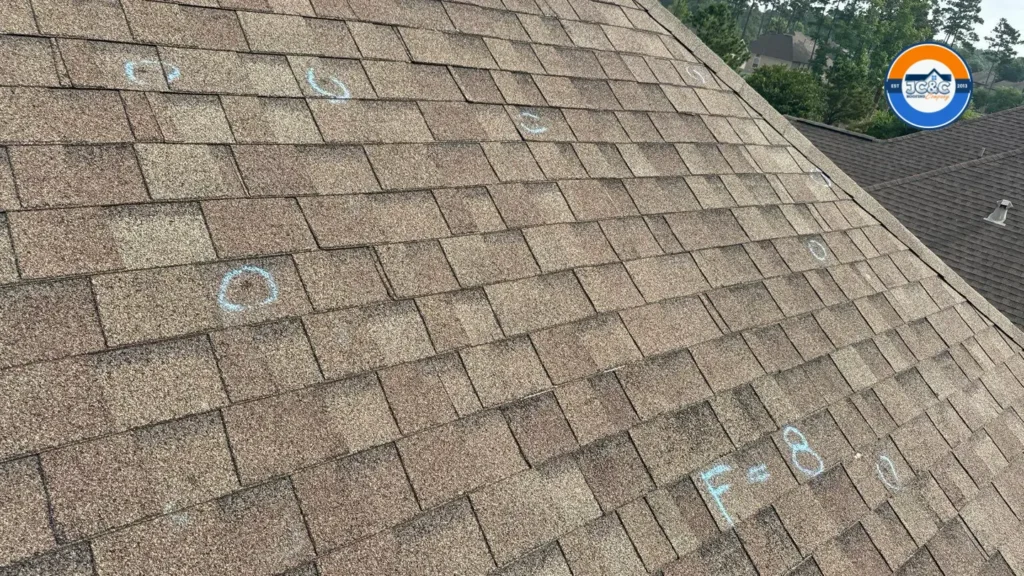
Bruising
A soft, dark spot where the fibreglass mat has fractured beneath the surface. Usually with granules missing. It feels slightly soft under a thumb, like a bruise on fruit.
- Random pattern across the slope
- No consistent direction or spacing
- Often on one or two slopes, not all
- Matching marks on soft metals
The mat fracture is what matters. That is the layer holding the shingle together, and once it is broken the shingle is on a countdown.
Not hail
Mechanical damage
Cracks and scuffs from something or someone on the roof — a fallen branch, a satellite installer, a previous contractor, or a homeowner clearing debris.
- Follows a path or a line
- Concentrated near penetrations or edges
- Scuffing rather than bruising
- No corresponding soft-metal marks
Adjusters recognize this immediately, and a claim built on it damages your credibility on everything else in the scope.
Not hail
Wear and tear
What fifteen Houston summers do. Granule loss, brittleness, cracking, perished pipe boots. Real damage — just not storm damage.
- Uniform across the plane
- Follows sun exposure — south and west slopes worst
- Consistent, not scattered
- Present before the storm
No policy covers this, ever. Filing on it is the fastest way to a denial. How old is your roof, really?


Hail size and what it does
¾″
Penny
Rarely damages asphalt shingles. May mark very soft metals.
1″
Quarter
Granule loss possible. Mat fracture uncommon on a sound roof.
1¼–1½″
Half-dollar
The threshold. Bruising becomes likely, especially on older shingles.
1¾″+
Golf ball and up
Damage very likely. Soft metals will show it clearly.
Age changes everything. A five-year-old roof may shrug off hail that finishes a fifteen-year-old one. Shingles get more brittle with every Greater Houston summer, which is why two neighbors in the same storm can get different answers.
The problem with hail specifically
It Does Not Leak, So Nobody Files
A bruised shingle keeps working. The mat is fractured underneath, but the surface is intact and water still runs off it. The roof looks and behaves exactly as it did the week before.
What has actually happened is that the shingle’s life has been shortened. The fracture opens slowly with every heat cycle, granules wash off the weakened area, and eventually — months or years later — water finds its way through.
By then the claim is difficult and often impossible. The storm was eighteen months ago, the damage has aged into something that looks like wear, and the insurer will say so.
What it looks like underneath, two years later
This Roof Was Damaged by Hail. Nobody Knew Until We Opened It.
This homeowner’s roof was hit by hail about three years ago. Nothing leaked, so no claim was ever filed. By the time the damage surfaced, the storm was too far in the past for it to be covered — and he is paying for the roof himself.
Christian Hernandez walking the roof. Water damage beneath the shingles, tracing back to hail bruising from a storm three years earlier — and from the ground, this roof looked fine the whole time.
This is the whole argument for filing promptly. The damage was real and it happened during a covered storm. But a roof that does not leak does not prompt a claim, and by the time anyone looks underneath, the loss has aged into something an insurer reads as wear rather than storm damage — and the homeowner pays.
Three clocks start the day the hail falls
01
Prompt notice
Your policy requires you to notify the insurer promptly once you know there is damage. It is a duty you agreed to, and it is separate from the filing deadline.
You can be inside the deadline and still be argued to have failed this.
02
The filing deadline
Usually set by your policy’s suit-limitation clause — commonly two years from the date of loss in Texas.
Long enough to feel relaxed. Short enough to miss entirely if the roof never leaks.
03
Evidence decay
This is the one nobody mentions. Hail damage ages. After two summers a fresh bruise looks like weathering, and the difference an adjuster relies on has faded.
No deadline governs this. It just quietly makes the claim harder every month.
Which is why a free inspection after a storm is worth taking even when nothing is leaking and you have no intention of filing. A dated report with photographs costs nothing and preserves the evidence while it is still fresh.
If there is damage
What Happens Next
-
Free inspection, documented
Every slope photographed, soft metals checked, the attic looked at where there is access. You get the photographs and a photo record whether or not there is damage, and whether or not you use us.
-
You file the claim
You do this, not us. Describe what you observed rather than what you think it will cost, and give the date of loss accurately — it anchors which deductible applies and which deadlines run.
Filing, negotiating and settling is licensed public-adjuster work. In Texas a roofer cannot do it, and anyone offering to is offering something they are not licensed for.
-
We meet your adjuster on the roof
So you are both assessing the same evidence rather than two different opinions formed separately. We show what we found and why we read it as hail rather than wear.
-
Scope, and supplements if it falls short
The first scope is written from a walk-round, and things get missed. A supplement is a documented request to add what was not visible then — normal rather than adversarial.
How Texas claims work — deductibles, depreciation and the deadlines that decide what you are actually paid.
-
The roof
On an approved claim we install GAF Timberline UHDZ with the Golden Pledge warranty as standard — a Class 4 impact-resistant shingle, because replacing a hail-damaged roof with the same grade means the next storm does the same thing.
Class 4 may also earn a premium credit. What TDI actually says about it
Where we inspect
Hail Damage Roof Repair Across Greater Houston
Hail falls in narrow bands, so the storm that hit one suburb often missed the next one entirely. Two offices — Tomball and Spring Branch — cover the metro, and a free inspection is the same free inspection wherever you are in it.
- Katy
- Cypress
- Spring
- The Woodlands
- Tomball
- Klein
- Magnolia
- Conroe
- Sugar Land
- Pearland
- Bellaire
- Spring Branch
Not on the list? The full service area covers most of Greater Houston. Call and we will tell you straight away whether your street is in it.
Common questions
Hail Damage Questions
How do I know if I have hail damage on my roof?
Check the soft metals first, from the ground. Aluminum dents far more easily than a shingle mat fractures — so if hail was big enough to bruise your shingles, it was more than big enough to dent your gutters, air conditioning fins and vents. If all of those are clean, be skeptical of anyone telling you the roof is finished.
Why doesn’t hail damage leak straight away?
Because a bruised shingle still works. The fibreglass mat is fractured underneath, but the surface is intact and water runs off it normally. The fracture opens slowly with heat cycling, granules wash off the weakened area, and water finds its way through months or years later — often after the claim window has closed.
What size hail damages a roof?
1¼ to 1½ inches is the usual threshold for bruising an asphalt roof. Below about an inch, granule loss is possible but mat fracture is uncommon on a sound roof. Above 1¾ inches, damage is very likely. Age changes everything — a five-year-old roof may shrug off hail that finishes a fifteen-year-old one.
What is the difference between hail damage and wear and tear?
Hail damage is a bruise — soft, dark, randomly scattered, with granules missing and the mat fractured beneath. Wear is uniform — it follows the sun, concentrates on south and west slopes, and looks the same across the whole plane. No policy covers wear, and filing on it is the fastest route to a denial.
How long do I have to file a hail claim in Texas?
Two clocks run. The filing deadline is usually set by your policy’s suit-limitation clause, commonly two years from the date of loss. But your policy also requires prompt notice once you know there is damage — a separate duty you can breach while still inside the deadline. Both clocks explained
A roofer knocked and said I have hail damage. Should I believe them?
Possibly — hail damage is real and often invisible from the ground. But ask them to show you the corresponding damage on the soft metals, and to photograph what they are pointing at. And note that during an inspection there is no reason for anyone to be lifting shingles or carrying a hammer.
Should I replace with impact-resistant shingles?
Worth considering, because replacing a hail-damaged roof with the same grade means the next storm does the same thing. On approved insurance claims we install GAF Timberline UHDZ with the Golden Pledge warranty as standard — a Class 4 shingle. TDI states Class 4 receives the highest premium credit of the four classes, though the amount is set by each insurer. The full guide
Recent storms we have inspected
We publish what we find after storms that hit a definable area — including when we find nothing.
Free hail inspection, honest answer
Every slope photographed, soft metals checked, photographs of everything we find, yours to keep — including when the finding is that your roof is fine.
A dated report costs you nothing and preserves the evidence while it is still fresh. That matters more with hail than with any other kind of damage.
All storm damage · How Texas claims work · Class 4 explained · What an honest inspection looks like
JC&C Roofing Company · 1431 Graham Dr #266, Tomball, TX 77375 · 1220 Blalock Rd #345, Houston, TX 77055 · hello@jccroofing.com